
Chief Investment Officers: Pay and Performance
by charles | Comments are closed10/31/2026

People say money isn’t everything. It’s not, but it’s right up there with oxygen. — Rita Davenport
What do chief investment officers earn at university endowments, you ask? We recruit these paragons of finance for a living and avidly track their accomplishments. In this letter we highlight the compensation of eighty-two CIOs and compare their pay to their endowment’s ten-year performance.
Our goal is to provide boards and investment executives with objective benchmarks and competitive insights as they work to attract, retain, and reward top talent.
The caveats
The IRS requires executive pay to be reported as of the calendar year ending within the organization’s fiscal year. But nonprofits are in no hurry to file these pesky public documents. They can take up to two years before reporting their finances, and most do.
And languid filings are just the half of it. The numbers are often scattered among frequently quirky databases in various jurisdictions with various disclosure rules. Sometimes the data is just not there. Some of the endowments included in our investment performance studies have, so far, only reported base salaries for their CIOs, so we don’t list them in this report.
Here’s one example. The University of Michigan does not file a separate form 990 with the IRS. The university considers the office a part of the school’s Business & Finance division and claims that as a government entity, it is not required to file form 990 under Treasury Regulation 1.6033-2(g).
Well, darn! This means we must rummage through administrative disclosures, public-records requests, business news, gossip columns, etc., to find comp info on Mr. Eric Lundberg, the university’s investment head. His base salary of $1,035,000 for CY 2024 is posted begrudgingly on the school’s executive salary website. But that’s all we find.
Yet, years ago the Chronicle of Higher Education reported his total comp as $3,420,164 for 2019 and $2,485,618 for 2021. Given the endowment’s excellent performance over Mr. Lundberg’s twenty-seven years as the university’s first and only CIO, I seriously doubt UofM whacked his pay.
School media, by the way, is another excellent source for compensation tidbits. We missed the 990 filing for Georgetown University as we assembled our CIO comp lists. But, thanks to the Georgetown Voice, we now know that Mr. Michael Barry received a base salary of $661,939 and bonus plus incentives of $1,047,554 for CY2024, his last full year as Georgetown’s CIO before moving on to Johns Hopkins University. Student reporters are badgers for truth.
Attribution:
One more thing. Our report is a snapshot not a movie. Many of the CIOs we cite have less than ten years at the helm. Moreover, a ten-year number by itself does not show the trajectory of performance or who contributed what and for how long.
During Scott Wilson’s tenure at Washington University, St. Louis (nine years and counting) the endowment has moved from fourth to top quartile to top decile, so he and his accomplished staff have delivered in spades for their school.
Others with less time on the bridge may have had to deal with legacy investment challenges. It can take years to right the ship.
The world we live in
For investors of all stripes, the last few decades have been quite a ride. A crash, recession, cheap money, new highs, then Covid, rallies, rates, and bubbles. “Double, double toil and trouble.” Some things never change.
But whatever the crises or Shakespearean struggles, CIOs are paid to make money for their schools, and somehow most do.
Our compensation review below.
—Charles Skorina
Our 2026 endowment performance report coming soon.
————————————————–
We present our compensation data in two tables. The first ranks total pay highest to lowest with the endowment’s corresponding ten-year performance alongside.
The second flips the criterion and ranks by the endowment’s ten-year performance with commensurate pay alongside.
(Chief Investment Officer pay and performance – PDF)
Read More »OCIO directory, fall 2026: think service
by charles | Comments are closed10/14/2026
If you don’t take care of your customer, your competitor will. —Bob Hooey, Make ME Feel Special!
Our fall 2026 Outsourced Chief Investment Officer (OCIO) directory features one hundred-five service providers with names, numbers, and emails for each firm.
Our goal is to give new business prospects – pensions, nonprofits, and family offices – an easy, ad-free, no-paywall, no-charge way to find OCIO firms and connect with the right representative.
Relentless growth
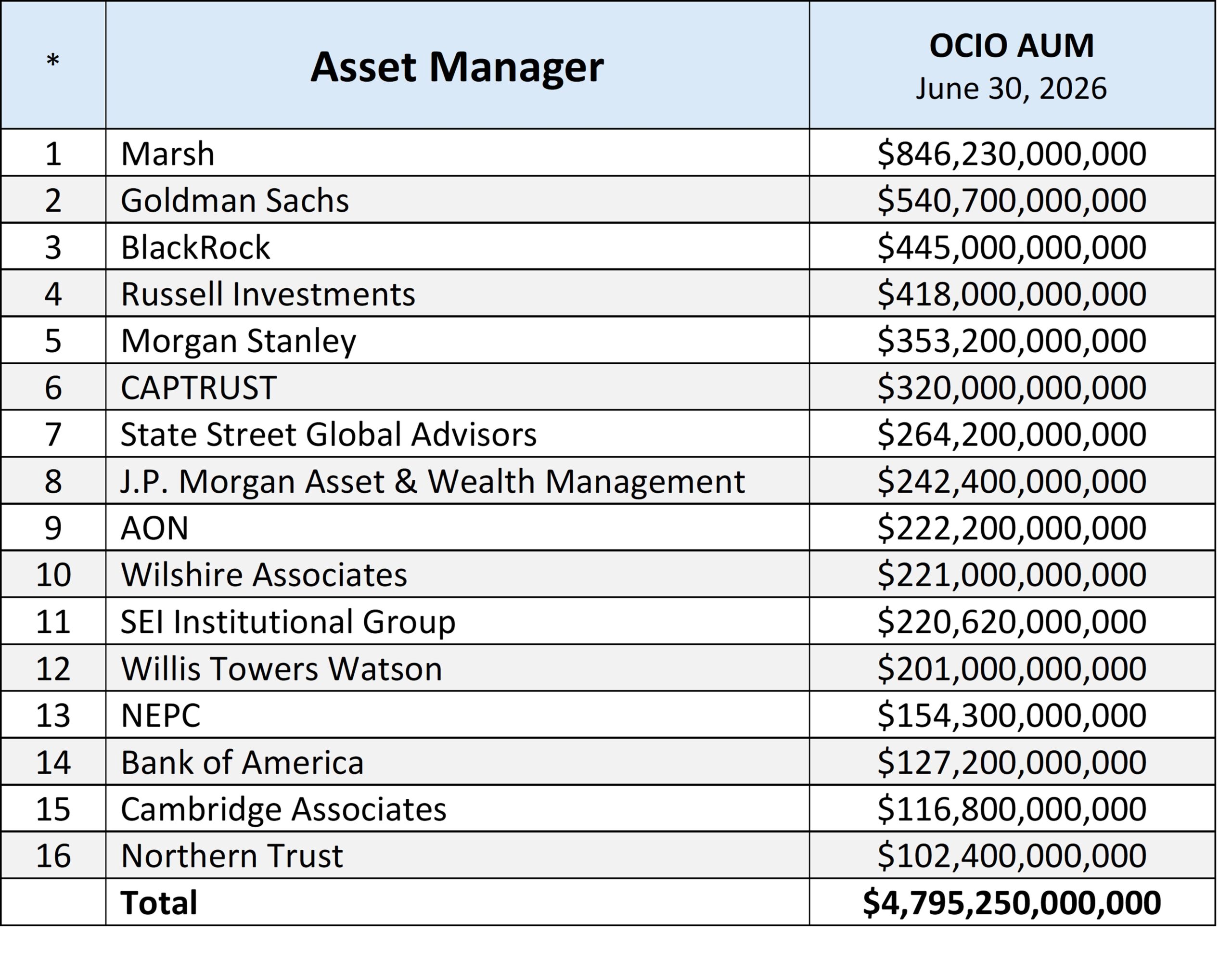
AUM topped $6.3 trillion as of June 30, 2026, an 11.8 percent jump ($666bn) from just six months ago. And, as usual, the big got much bigger. Sixteen firms over one hundred billion manage about seventy-six percent of the assets (mostly pension assets) leaving the remaining trillion-five for independents and boutiques.
Looking back over the last four decades, the best time to pitch an outsourced OCIO proposition was probably about thirty years ago. Fewer competitors, better margins, plenty of prospects. But there’s still runway ahead for the go-getters. Here’s a rough estimate of total investable assets for the nonprofit, non-pension market:
$1.786 trillion – private foundations
$0.177 billion – community foundations
$1.000 trillion – endowments
$0.600 billion – hospitals, health systems
$0.300 billion – religious organizations
$0.070 billion – museums
$3.933 trillion
The corporate defined benefit business is a land unto its own, actuarial, regulated, and liability driven, with a focus on funding levels and cost reduction. Better to let Marsh, Goldman, Blackrock, et al., deal with those headaches.
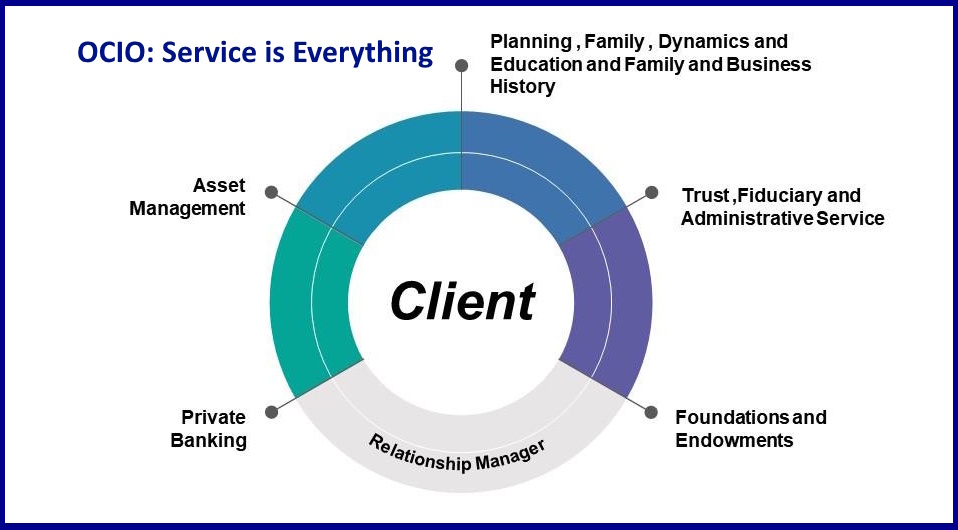
New business for most OCIOs will come from private wealth and related foundations, a booming market. But when it comes to the moneyed class it’s all about service.
Speaking of service
A sizable southern foundation called a few weeks ago to discuss their OCIO’s poor service. Didn’t matter that the 10-year investment performance was excellent – our data put them in the top third. According to the board their OCIO responds late to their requests and pays lip service to their concerns. They were here to talk about a change.
When families are asked what qualities are most important in a client service advisor, trust and responsiveness top the list. And yet, after twenty years working with OCIOs – recruiting, consulting, M&A, this directory – poor service and communication is today’s number one complaint.
Maybe it’s turnover and the lamentable loss of passion and focus. Once a founder sells it’s hard to sustain that intensity and vision. Most OCIO trailblazers have been in business for thirty to forty years, some longer, and many are aging out.
Unless an OCIO is family-owned like Hirtle & Co. with succession in place, or that rare private partnership with a two-hundred-year-old history like Brown Brothers Harriman, merging is usually inevitable.
With heady valuations, it’s hard to say no to a generous offer. In the last few years, Hall Capital, NEPC, Agility, Truvvo, Ellwood Associates, New Providence, CornerStone, PFM, and Permit Capital, among others, have snuggled up to big money patrons.
Mr. Hirtle, industry doyen and long-standing client, describes the challenge this way:
Over the past decade and more, markets have been so consistently productive that almost everyone is capturing historically strong returns. So, differentiation in our business depends on exceptional professional service.
Daniel Kahneman famously differentiated the perfectly rational humanoid “econs” of the economic textbooks – who only care about performance – from real people with real everyday emotions, pressures, and concerns which he called “humans”.
Exemplary service means focusing on our clients’ success and well-being, those human elements Professor Kahneman describes. Our mission is to ease their minds and help keep their commitments. We never want to disappoint them. That means both strong performance and great client care.
—Charles Skorina
Read More »