
Better boards, busy bots
by charles | Comments are closed07/29/2026
Making money is art –Andy Warhol
Today’s newsletter is short and mostly sweet. First, helpful hints on building great boards and investment teams, but then some doubts on how much longer it might matter as bot-views and agentic overlords commandeer portfolio management.
Board work matters
A pithy primer on Washington University’s remarkable investment resurgence posted recently on LinkedIn. Clark Hoover, investment officer at the Los Angeles City Employees’ Retirement System read our report on the WashU endowment board’s laudable work and thoughtfully excerpted key dos and don’ts for his nonprofit peers.
When insights come our way – from in-depth interviews with industry veterans, for example – we feel obliged to pass them on to our savvy readers. As ‘frontier’ novelist Louis L’Amour wrote “Knowledge is like money: To be of value it must circulate.”
“What the best boards do:
- Stay aligned and engaged — committed, collaborative, and focused on long-term success.
- Keep governance lean — typically 5–7 members, low turnover, and average board tenure of 10+ years.
- Provide strategic clarity — establish clear objectives, define expectations for the investment team, and evaluate and compensate staff objectively.
- Focus on governance, not management — the board owns strategic asset allocation while empowering investment staff to execute.
What weaker boards tend to do:
- Overcrowd the boardroom — too many voices, high turnover, and excessive micromanagement.
- Send mixed signals — discourage prudent risk-taking while expecting outsized returns.
- Underinvest in talent — reluctance to pay competitively often leads to weaker performance and higher staff turnover.
Strong governance doesn’t guarantee strong investment results—but weak governance makes results much harder to achieve.”
One reader noted, however, that public pensions often have slots set aside for government and union representatives which crowd the boardroom. When it comes to public plans and their financial sway, everyone wants a seat at the table.
Iconoclasts are few and far between and CIOs on many campuses have little room to run, even when they want to. So, if most institutional portfolios look and act the same, why not just give in to AI and the algorithms? It’s cheaper, easier, and when something goes wrong, blame it on those ghosts in the machines.
Sophisticated quant strategies proliferate on Wall Street, ETFs have taken over Main Street, and AI chatbots and robo-advisors swarm financial services. In the world of HR and talent acquisition, algorithms and predictive tools are here in force and impact hiring and career advancement.
Our cyber symbiotes don’t just ease the workload they free us from the tyranny of choice. Decisions without responsibility or regret, every bureaucrat’s dream.
But there are always tradeoffs. Disruptive innovation hits hard and the effects can be brutal. As the automobile swept America, replacing the real life power of horses, entire industries collapsed. Stables, blacksmiths, harness makers, feed suppliers, auction houses, investors; so many livelihoods gone.
So, here’s my worry. These AI dislocations affect perception as well as reality. With deepfakes and synthetic friends, hallucinations and digital shadows, it’s hard to know what part of our digital collective is real.
Financial advisors, analysts, CIOs, all those corporal inhabitants in our world of finance and asset management, in ten years’ time will they still be human? Investing is all about trust and responsibility. AI doesn’t care.
—Charles Skorina
Read More »OCIO Directory Summer 2026: traditional values
by charles | Comments are closed07/04/2026
Customers may forget what you said but they’ll never forget how you made them feel. – Maya Angelou
Our summer 2026 Outsourced Chief Investment Officer (OCIO) directory features one-hundred-eight service providers with contact names, numbers, and emails for each. Our goal is to help families and institutions locate, review, and connect with full-service discretionary outsource investment managers. No ads, no paywall, no charge.
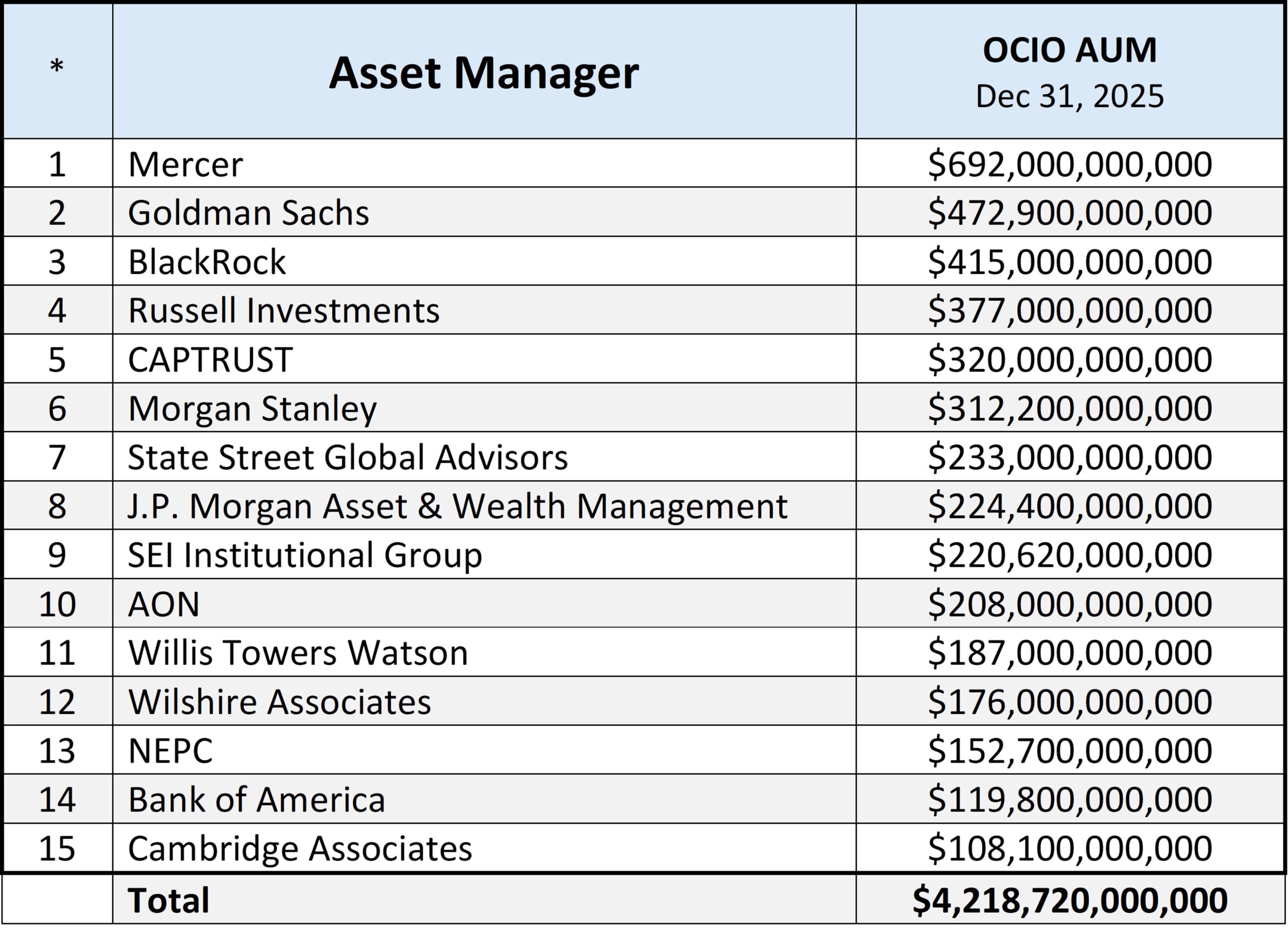
OCIO AUM reached $5.64 trillion at the end of 2025, an 8.9 percent jump ($463bn) from a year ago. And, as usual, the big got bigger. Fifteen firms over one hundred billion manage about seventy-five percent of the assets (mostly pension assets) leaving roughly a trillion four for the pros and pretenders.
Keeping commitments
The outsourced full-discretion investment business is hyper-competitive, hard to differentiate, and expensive to scale, with hundreds of players including RIAs, banks, brokers, and asset managers all competing for institutional and ultra-high-net-worth discretionary mandates. It’s hard to cut through the clutter.
Worse still, few OCIOs are able to convincingly explain their competitive edge or why it should matter. Most firms read the same on paper. So when it comes down to finals, empathy and likeability usually clinch the deal.
My conclusion after years working with both OCIOs and their clients? Families and nonprofits really don’t care about a firm’s “passion for investing.” They care about service and security and keeping promises, not swaps and overlays and some proprietary secret sauce.
Investment performance may rule one out, but it’s seldom the reason for a winning selection.
The OCIO story is a compelling proposition for many institutions and high-net-worth families, but it’s an intensely competitive arena. If you are not taking care of your client, someone else will.
Stepping up, or stepping out
While some OCIOs up their game, others are moving on. FEG and Hirtle & Co. recently rebranded and reaffirmed their commitments, while Cambridge Associates redoubled its efforts and topped $100 billion full-discretion AUM. Organic growth, not M&A.
Others like Mill Creek, Verus, RockCreek, and Russell (yet again?) have decamped for better-resourced patrons. And, just the other day, Fiducient Advisors, part of Wealthspire, now owned by Madison Dearborn Partners, recently announced plans to acquire Sellwood Investment Partners. M&A every which way.
Without a plan for succession and the resources to compete there’s little choice but to sell or merge.
Speaking of which, we have a client, a regional financial corporation with significant multi-state banking and investment operations, who is seeking to augment their full-discretion, investment management capabilities through acquisitions, mergers, and creative partnerships. In short, we’re looking for a few like-minded OCIOs. Call us if you would like to discuss.
Hirtle & Co., fresh paint, time-honored values
While we’re on the subject of client-centric care, take a look at Hirtle & Co.’s recent rebrand, a firm I’ve known for years. In the firm’s letter to clients managing director Susan McEvoy captures the essence of money and mission:
“What matters more to us is what that capital [client AUM] is multiplying in the world: medical research, education, the arts, and the communities we call home; missions that outlast all of us.”
In founder Jon Hirtle’s words, “I joined Goldman right out of the service (The Marine Corps), with a strong sense of idealism and mission. On my first day in training, I asked my mentor to describe ‘the noble cause.’ He immediately replied, ‘The client.’” That said it all.
Who’s who
If a firm says they provide OCIO services, and their website suggests they do, we’ll usually list them upon request.
However, each OCIO has its own culture, client mix, investment style, and biases. Some firms focus on indexing and liquid markets, others on alternatives, still others on ESG. Some customize portfolios for clients, others don’t. Big, small, specialists, generalists, there’s no lack of choice.
Our advice? When shopping for an OCIO, it pays to be thorough. I recently reviewed investment office performance, operations, and talent with the board of a major university. After numerous interviews with trustees and chief investment officers at peer institutions, my final report included one particular caveat: an OCIO relationship is a marriage not a fling. Once a family or foundation commits to a partner, the bond is not easily undone.
—Charles Skorina
(down PDF newsletter & directory)
Read More »