
Smart money
by charles | Comments are closed08/06/2025
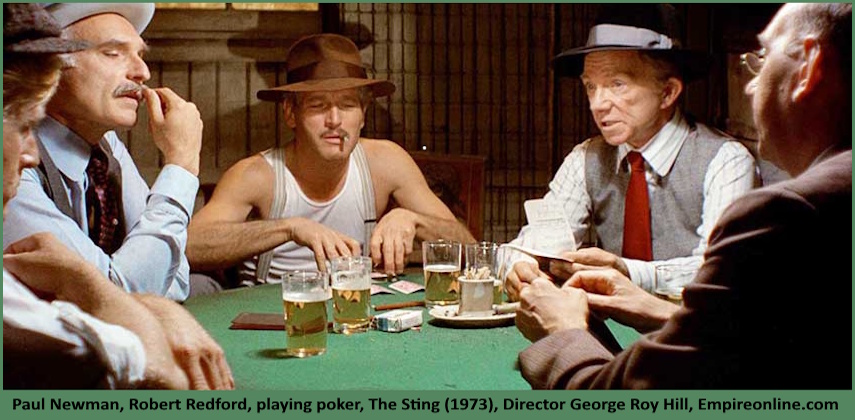
If I disagree with something, I either bet against it, or I keep silent – Amarillo Slim
It’s been a festive fifty years for the alternative investment industry, with private equity the belle of the ball. And as Chuck Prince, former CEO of Citigroup once remarked, “as long as the music is playing, you’ve got to get up and dance.” But no matter how compelling the party, there are usually a few contrarians lingering in the wings.
Ken Frier, CEO of OCIO firm Atlas Capital Advisors, wrote recently that “The signs are clear, the non-profit model, where the energy goes toward selection of alternative investment managers, is bearing less fruit.
That’s the case even for the Yale endowment – their performance beat a simple 90/10 stock/bond index portfolio by 6.2% in 1994 – 2004, by 3.6% in 2004 – 2014 and just 1.2% in 2014 – 2024. And that 1.2% in the past decade is overstated since Yale cannot sell their private holdings at the reported value.”
Maybe so, but with private equity forecast to double from $5.8tn in 2023 to $12.0tn in 2029 and the “barbarians” storming the retail 401(k) ramparts, one can’t help but wonder what the smart money is up to. As Ben Carlson, A wealth of common Sense, quipped, “being a contrarian is easier in hindsight.”
Most big dollar state pensions still follow the herd. CalPERS recently announced they’re going large on private assets with a target 40% allocation, about $225 billion of the $563 billion dollar fund.
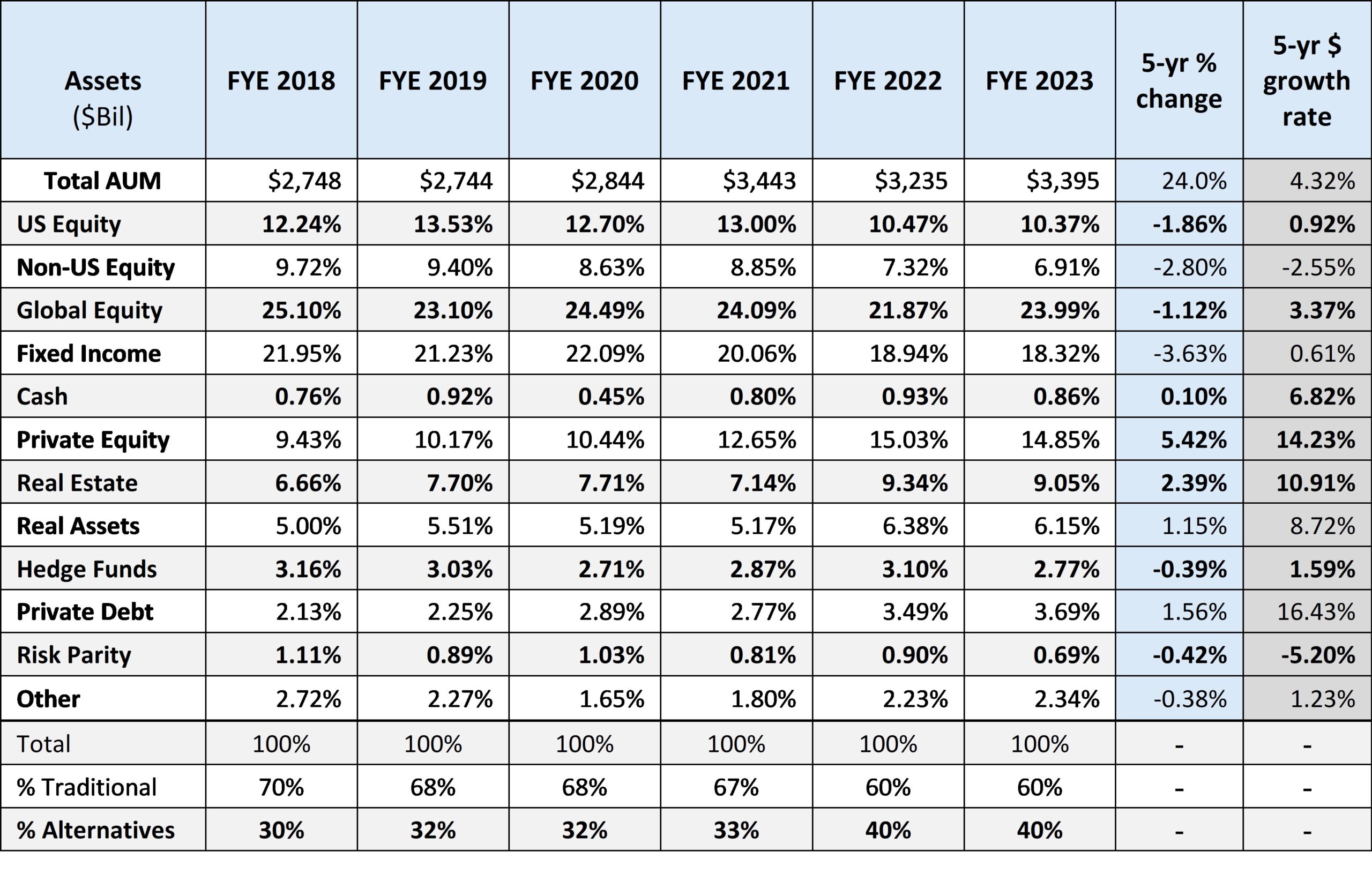
As for CalPERS peers, Stephen L. Nesbitt, CEO & CIO of institutional consultant Cliffwater reported last year that allocations to alternatives reached 40% of state pension assets in 2022, with PE at 14.85% as of 6-30-23.
State Pension Allocations
June 30, 2018 to June 30, 2023
Non-profit Investment staffs try their best, but most go to the same conferences, use the same consultants, follow the same trends, and invest with the same managers as their peers. Career risk is too great to “think different” when politicians and media trolls lie in wait for any and every mistake.
Pinching pennies
Despite the grumbling, fees still don’t seem to matter much to the institutional crowd. Richard Ennis, former co-founder of consulting firm EnnisKnupp (now AON), thinks the herd pays too much for too little.
“Alts bring extraordinary costs but ordinary returns – namely, those of the underlying equity and fixed income assets.” Ennis finds big endowments in his study – estimated to hold 65% of assets in alternative investments – fare worse than pensions, which have a 35% exposure.
When compared with a market index that he designed with a specific stock-bond mix to mimic funds’ risk profile, endowments have trailed by 2.4 percentage points annually in the 16 years through June 2024. Over the same period, pensions undershot their benchmark by 1 percentage point a year.”
Callan recently published their 2025 Cost of Doing Business Study – “a comprehensive look at the investment management fees paid by institutional investors.” Here are a few highlights from the press release:
“Total investment management fees averaged 40 basis points (bps) across all asset pools. But this headline figure masked significant variation across investor types:
- Nonprofits continued to pay the most, averaging 57 bps, driven by larger allocations to alternatives.
- Public funds averaged 43 bps, but the largest plans resembled nonprofits in both structure and fees.
- Corporate funds averaged 30 bps, driven by growing use of liability-driven investing (LDI).
- Insurance pools, with their conservative asset allocations, were the lowest at 20 bps.”
To be fair
Read More »