
If you don’t take care of your customer, your competitor will. —Bob Hooey, Make ME Feel Special!
Our fall 2026 Outsourced Chief Investment Officer (OCIO) directory features one hundred-five service providers with names, numbers, and emails for each firm.
Our goal is to give new business prospects – pensions, nonprofits, and family offices – an easy, ad-free, no-paywall, no-charge way to find OCIO firms and connect with the right representative.
Relentless growth
AUM topped $6.3 trillion as of June 30, 2026, an 11.8 percent jump ($666bn) from just six months ago. And, as usual, the big got much bigger. Sixteen firms over one hundred billion manage about seventy-six percent of the assets (mostly pension assets) leaving the remaining trillion-five for independents and boutiques.
Asset Managers over $100bn AUM
$846,230,000,000 – Marsh
$540,700,000,000 – Goldman Sachs
$445,000,000,000 – BlackRock
$418,000,000,000 – Russell Investments
$353,200,000,000 – Morgan Stanley
$320,000,000,000 – CAPTRUST
$264,200,000,000 – State Street Global Advisors
$242,400,000,000 – J.P. Morgan Asset & Wealth Management
$222,200,000,000 – AON
$221,000,000,000 – Wilshire Associates
$220,620,000,000 – SEI Institutional Group
$201,000,000,000 – Willis Towers Watson
$154,300,000,000 – NEPC
$127,200,000,000 – Bank of America
$116,800,000,000 – Cambridge Associates
$102,400,000,000 – Northern Trust
$4,795,250,000,000
Looking back over the last four decades, the best time to pitch an outsourced OCIO proposition was probably about thirty years ago. Fewer competitors, better margins, plenty of prospects. But there’s still runway ahead for the go-getters. Here’s a rough estimate of total investable assets for the nonprofit, non-pension market:
$1.786 trillion – private foundations
$0.177 billion – community foundations
$1.000 trillion – endowments
$0.600 billion – hospitals, health systems
$0.300 billion – religious organizations
$0.070 billion – museums
$3.933 trillion
The corporate defined benefit business is a land unto its own, actuarial, regulated, and liability driven, with a focus on funding levels and cost reduction. Better to let Marsh, Goldman, Blackrock, et al., deal with those headaches.
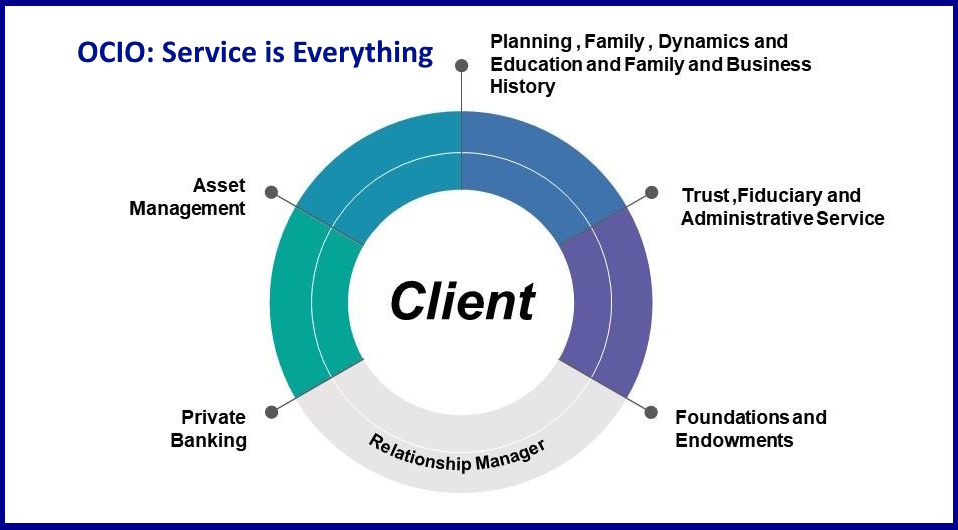
New business for most OCIOs will come from private wealth and related foundations, a booming market. But when it comes to the moneyed class it’s all about service.
Speaking of service
A sizable southern foundation called a few weeks ago to discuss their OCIO’s poor service. Didn’t matter that the 10-year investment performance was excellent – our data put them in the top third. According to the board their OCIO responds late to their requests and pays lip service to their concerns. They were here to talk about a change.
When families are asked what qualities are most important in a client service advisor, trust and responsiveness top the list. And yet, after twenty years working with OCIOs – recruiting, consulting, M&A, this directory – poor service and communication is today’s number one complaint.
Maybe it’s turnover and the lamentable loss of passion and focus. Once a founder sells it’s hard to sustain that intensity and vision. Most OCIO trailblazers have been in business for thirty to forty years, some longer, and many are aging out.
Unless an OCIO is family-owned like Hirtle & Co. with succession in place, or that rare private partnership with a two-hundred-year-old history like Brown Brothers Harriman, merging is usually inevitable.
With heady valuations, it’s hard to say no to a generous offer. In the last few years, Hall Capital, NEPC, Agility, Truvvo, Ellwood Associates, New Providence, CornerStone, PFM, and Permit Capital, among others, have snuggled up to big money patrons.
Mr. Hirtle, industry doyen and long-standing client, describes the challenge this way:
Over the past decade and more, markets have been so consistently productive that almost everyone is capturing historically strong returns. So, differentiation in our business depends on exceptional professional service.
Daniel Kahneman famously differentiated the perfectly rational humanoid “econs” of the economic textbooks – who only care about performance – from real people with real everyday emotions, pressures, and concerns which he called “humans”.
Exemplary service means focusing on our clients’ success and well-being, those human elements Professor Kahneman describes. Our mission is to ease their minds and help keep their commitments. We never want to disappoint them. That means both strong performance and great client care.
—Charles Skorina
————————————————-
Looking for an OCIO partner
My client, a regional financial corporation with significant multi-state banking and investment operations, is looking for an OCIO to acquire with management firmly in place and ambition intact.
The goal is to combine the group’s financial heft with an OCIO’s management expertise and desire for long-term growth.
This is a strategic initiative. No flips, no quick turns. If you’re looking for a partner with similar goals, please give me a call.
skorina@charlesskorina.com
520-428-4180
————————————————–
Build or Buy
Reading about the Kirsh family office build out in the WSJ the other day reminded me of all the unhappy CIOs I’ve interviewed from offices that eventually blew up. Where families are concerned, sometimes it’s better to let objective, independent professionals handle the investing.
Family office heads have enough on their plates—estates, foundations, investments, art collections, and organizational issues; implement an accounting and reporting infrastructure; establish generation-skipping trusts; manage personal properties and staff; and navigate the delicate task of educating and mentoring family members. And did we mention taxes, taxes, taxes?
Ron Chernow’s definitive biography on John D. Rockefeller, “Titan”, should be required reading for all UHNW moguls thinking of reinventing the family office wheel. Mr. Rockefeller essentially created the modern American corporation, warts and all. And his family office and philanthropic endeavors are legendary role-models for modern philanthropists and family wealth managers.
Before you jump, however, think carefully. When a family decides to build an investment office, they are in fact preparing to design, launch, and manage a profitable business, one that is likely quite different from the one that built the wealth in the first place.
Josh Baron and Rob Lachenauer, Is Your Family Office Built for the Future?, highlight five key decisions that govern success. They are:
• Design: How will you own your assets together?
• Decide: How will you structure governance?
• Value: How will you define success?
• Inform: How will you communicate with your family?
• Transfer: How will you transition to the next generation?
There are very few founders like Mr. Nathan Kirsh, a 94 year old indomitable Jewish South-African/American entrepreneur. The firms in our directory have worked with families and institutions – and related private foundations – for decades, some for centuries. They have the institutional structure, scale, and expertise to meet all challenges. For most UHNW families, an outsourced solution is a safer choice.
(download PDF directory only)
(down PDF newsletter & directory)
