
OCIO Directory Fall 2025: So many!
by charles | Comments are closed11/19/2025

The price of ability does not depend on merit but on supply and demand. – George Bernard Shaw
For our summer 2023 OCIO directory we wrote: Despite the Nasdaq losing a third of its value, 33%, the Russell 3000 down by 20.48%, the S&P 500 off 20%, and the Dow shedding 9%, total outsourced assets on our list dipped a tenable 9.5%, or $356 billion to $3.4 trillion.
How quickly time flies. Today, with global markets hitting record highs, our latest directory flush with providers, and related AUM over five trillion dollars, discretionary outsourcers of every persuasion are charging ahead chasing assets and fees.
But we can’t help but wonder, are there really that many fully-integrated, conflict-free, financially-grounded, independent investment offices – to paraphrase Hirtle Callaghan’s raison d’etre – fit and able to serve the needs of families, foundations, and related nonprofits?
Supply and demand
There’s torrential demand as waves of new money seek professional advice. And a supply gusher as stalwarts and wannabes rewire their practices for OCIO prospects.
Every week it seems someone we’ve never heard of with three, four hundred million comes calling. Their wealth has surged, they’ve funded a foundation – or sit on the board – and it’s all getting out of hand. Everyone’s after a piece of their pie, they’ve browsed through our directory, and they’re looking for a firm they can trust.
“The US commands an extraordinary 34% of global liquid private wealth and houses 37% of the world’s millionaire population according to the latest Henley & Partners wealth report. And this wealth dominance extends across all brackets, with 36% of the world’s centi-millionaires (those with USD +100 million) and 33% of its billionaires residing in the US.”
Eying the celestial end of the wealth spectrum, the Wall Street Journal reports: “The net worth held by the top 0.1% of households in the U.S. reached $23.3 trillion in the second quarter this year, from $10.7 trillion a decade earlier, according to the Federal Reserve Bank of St. Louis. The amount held by the bottom 50% increased to $4.2 trillion from $900 billion over that period.”
The big squeeze
Pricing plans are crumbling as cost increases and fee compression undercut margins. Revenue on managed assets topped $58 billion in 2024 announced Boston Consulting Group, but almost three-fourths of the gain (70%) came from market performance and a move to lower-priced products.
Meanwhile, it takes a small fortune to field a full-service institutional grade practice as compensation, sourcing, due diligence, cyber-security, audits, and compliance expenses continue to climb.
“Shifts in product offerings and approaches to distribution, industry-wide consolidation, and the need for radically leaner cost structures” are behind the squeeze. To fatten margins, BCG suggests offering actively managed assets such as active ETFs, model portfolios, and separately managed accounts, and offering private assets to retail clients.
But therein lies a dilemma. To truly serve clients, aren’t discretionary outsourcers obliged to avoid the conflicts and temptations endemic in money management? Alicia McElhaney, Institutional Investor, describes the quandary:
“A pioneer in the outsourced chief investment officer business says it’s necessary to be both a pure-play provider — with no products to sell — and have scale. A large asset manager believes disclosing and managing potential conflicts is enough. A search consultant says no OCIO is truly free of competing interests.”
OCIOs everywhere
What exactly is an outsourced chief investment officer? To date there’s no industry standard or designated authority to police the usurpers.
We publish our directory to help families and institutions locate, review, and connect with full-service discretionary outsource investment managers. If a firm says they provide OCIO services, and their website suggests they do, we usually, though not always, add them. But there sure are a lot of them.
[For this issue we removed five firms and added one, Third Lake Partners.]
Institutional grade OCIOs are sophisticated operations. The crème de la crème have years of experience – time to fully hone systems, service, succession, and investment capabilities. Hirtle Callaghan and Blackrock opened for business in 1988, McMorgan & Company set up shop in 1969, Brown Brothers Harriman and JPMorgan Chase date back over two centuries.
Adding to the muddle, each OCIO has its own culture, client mix, investment style, and biases. Some firms focus on indexing and liquid markets, others on alternatives, still others on ESG. Some customize portfolios for clients, others don’t.
Final thoughts
The outsourced full-discretion investment business is hyper-competitive, hard to differentiate, and expensive to scale, with hundreds of players including RIAs, banks, brokers, and asset managers all competing for nonprofit and UHNW discretionary mandates. It’s hard to cut through the clutter.
To quote one industry veteran: “As more and more thoughtful investors recognize the power and promise of OCIO, it’s time to review its three primary requirements.
- A Conflict-Free Structure: OCIO requires a structure that is conflict-free and truly open architecture with no products or hidden corporate agendas to confound decision making.
- Purchasing Power: OCIO requires sufficient purchasing power to pay for talent and support to fully exploit global complexity, noise, and opportunity.
- An Investment Management Culture: OCIOs require a point-accountable, investment management culture.”
Our advice? When looking for an OCIO, it pays to be thorough. Once a family or foundation (or pension fund, healthcare system, insurance company, etc.) commits to a partner, an OCIO relationship is not easily undone.
Charles Skorina
————————————————–
Outsourced Chief Investment Officer
(OCIO) Directory, Fall 2025
Read More »Changing Times
by charles | Comments are closed10/13/2025

“People don’t know what they want until you show it to them.” — Steve Jobs
The late David Swensen, Yale’s formative chief investment officer, found value in dark corners, those unknown managers and overlooked opportunities Heather Gillers referred to in a recent WSJ article. But there hasn’t been much new in money management since Mr. Swensen wrote the playbook.
Whether non-correlated, factor-based, or managed TPA, when we do our ten-year return studies most institutional portfolios look and act the same.
So, here’s a question. If most investment managers think alike, what’s to keep AI and algorithms from taking their jobs?
Barter to Bitcoin
Disruptive technologies and blockbuster products, computers and ETFs, come around maybe once every fifty years, so the time seems ripe for the next big thing — those creative convulsions Professor Clayton Christensen warned about.
Here’s a piece that caught our eye, an excerpt from an article on AI, crypto, and seismic change by Caltech grad and tech founder Ryan W. Sinnet, PhD. A vignette about horses.
In 1920, America reached peak horse: 25 million animals powering the nation’s economy.
But the end had already begun in the cities. In 1910, New York City housed 128,000 working horses, according to the NYC Department of Records. They pulled carriages, delivered milk, hauled freight.
Every morning, thousands of horses trudged through Manhattan streets, their iron shoes striking cobblestones in a rhythm that had echoed through cities for centuries. Smart money owned stables, carriage companies, hay distribution networks. The horse industry wasn’t just big—it was civilization itself. Unthinkable to replace.
Yet by 1920—even as rural America reached peak horse—New York’s horse population had already collapsed to 56,000, more than half gone in a single decade. The transformation was already accelerating.
By 1912, New York City had 38,000 motor vehicles on its streets, and the automobile age had clearly arrived. By 1917, the last horse-drawn trolley made its final trip.
The entire ecosystem that supported horse labor—stables, blacksmiths, harness makers, feed suppliers, auction houses—didn’t evolve or adapt. It vanished. The 25 million horses that powered America in 1920 plummeted to just 3 million by 1960.
Those horses never came back.
Relationships matter
Chatbots, robo-advisors, Zoom, and the cloud are now obligatory parts of the financial landscape. Generations born in the internet age seem fine without the human touch as long as their assets are globally accessible, secure, and earn enough to pay the bills.
But that’s on the retail side. These “digital natives” may be inured to “Tilly Norwoods” and “Schwab Intelligent Portfolios,” but how about foundations, endowments, and UHNW families with large diverse holdings? Might they still want a human at the helm? Someone who “understands their needs and speaks to their sensibilities” as Ken Tsuboi, chief investment officer at McMorgan & Company describes constructive client engagement.
Successful wealth stewards embrace the goals, aspirations, lifestyle preferences, and risk tolerances of their clients. Kathryn George, Partner, Brown Brothers Harriman points out that “Wealth is never just about money. It’s intimately intertwined with relationships – between generations, between values, and between expectations.”
We tallied a record high $4.865 trillion dollars in outsourced assets in our last OCIO report. Rich Nuzum at Franklin Templeton counts the “rise of private market alternatives; the global war for in-house investment talent; the data, digital and technology arms race; and the increasing number of asset owners questioning the need to manage investments in-house” as major factors driving growth.
Funds and families with two billion or more may have the means to field internal investment capabilities, assuming they have the time and patience to build, staff, monitor, and maintain such a business. But for those with less regal sums, outsourcing the complexities and risks to professionals they trust is an effective way to keep their commitments and secure their legacy.
Final thoughts
According to Altrata’s World Ultra Wealth Report 2025 “the total net worth of the UHNW class rose by 6.7% to $59.8tn at the end of June 2025 (and by 11.6% in 2024) – a figure double that of the annual GDP of the US.”
That’s encouraging. After all, managing money is one of America’s key competitive advantages. And we recruit the managers who manage the money.
And yet . . . I can’t help but worry.
“Not because AI does everything better, but because it does enough things cheaply enough that the economics become undeniable” as Dr. Sinnet contends.
About twenty years ago, I had lunch with the EVP of Equities at a major west coast mutual fund company. A fellow University of Chicago grad, he was smart, savvy, and successful, but the lunch ended on a sour note when I remarked that Index funds and ETFs might be a problem down the road for the full-load fund business. Right comment, wrong company.
“I obviously had no idea what I was talking about,” he snapped. “These ETFs are a gimmick with a niche future at best. Clients want the human touch and always will. And they will continue to pay for it.”
Not so long after our lunch he left the firm – retired early I heard – and that giant fund warehouse has had a bumpy ride since.
As Andy Grove, the former CEO of Intel used to say, “only the paranoid survive.” Me? I keep looking over my shoulder.
— Charles Skorina
Read More »Pay and Performance at Private Foundations
by charles | Comments are closed10/04/2025

What’s worth doing is worth doing for money. — Gordon Gekko (Michael Douglas) Wall Street
What do investment professionals earn at nonprofit institutions? We recruit these executives for a living, so we avidly track their pay and performance.
In this letter we highlight the compensation of one-hundred twenty-eight chief investment officers and staff at private US foundations and tie their pay to five-year performance.
Our goal is to give boards, CEOs, and CIOs a useful set of benchmarks as they consider what to pay their investment executives.
FoundationMark
As always, when it comes to foundation research we draw on the impressive data set from our good friend John Seitz, CEO of FoundationMark.
We think his research and rankings are excellent companions to our pay and performance studies, of interest to asset owners and all purveyors of investment products and services.
The Business of Philanthropy
While college endowments garner most of the media attention, foundations embrace a much larger market, both in numbers and assets.
Over the last thirty years the number of foundations has tripled from about 40,000 in 1995 with assets of $373.4 billion to nearly 120,000 holding $1.6 trillion today. One report puts total nonprofit assets at over $8 trillion dollars.
By comparison, the 2024 NACUBO-Commonfund Study of Endowments lists 658 U.S. colleges and universities and affiliated foundations with $873.7 billion in assets.
Nonprofits are major employers in almost every state. Did you know that:
- The nonprofit workforce is 12.5 million strong, making it the third largest “industry” in the U.S., outdistancing all but two major for-profit industries in its contribution to state employment and payrolls.
- Nonprofit employment is dynamic, growing more rapidly over time than overall employment.
- Nonprofit wages actually exceed for-profit wages in many of the fields where both sectors operate.
(How does foundation pay compare to Wall Street money, you ask? These Heidrick & Struggles comp surveys on alternative asset managers and private equity professionals suggest it’s a toss-up.)
Performance
Unlike academia with its traditions of open access and publish-or-perish, foundations have no impetus to reveal or publish much of anything, particularly investment data, and few do, less than .01%.
As Professors Matteo Binfare and Kyle Zimmerschied found while drafting a paper on foundation investing: “There is little research to date on the investment performance of private foundations.”
Undaunted, Mr. Seitz and staff have developed a system which tracks and estimates the investment performance of most foundations in the nonprofit universe. But please keep in mind that these numbers are estimates based on 990 data, not public pronouncements from the foundations.
Moreover, there’s a long lag – a year and a half to two years – before compensation data is publicly available. Hence, the comp numbers in our table are mostly as of December 31, 2023, with a handful from March and June 2024.
Pass the gravy
Charity often comes down to semantics.
Large private foundations pay their employees well, and for the most part they provide substantial public benefits. The more foundations earn, the more they give away. That’s how the system is supposed to work.
But there are exceptions. We wrote about one case a while back of too much charity staying at home. And Professors Nathan Born and Adam Looney assert in “How Much Do Tax-exempt Organizations Benefit From Tax Exemption?” (pg.8) that a few nonprofit beneficiaries seem reluctant to share their tax-free bounty.
The OCIO Option
The OCIO industry has grown dramatically over the last forty years for good reason, managing institutional money is expensive. It takes time and resources to build a competitive, institutional-grade investment office, and staff compensation alone can run seventy-five to eighty-five percent of total costs.
The top three foundations in our table, for example, disclose investment staff comp of $13,438,547 for the Hewlett, $12,400,949 for the Ford, and $11,133,746 for the Moore, but that’s only for the highest paid employees. The actual investment office headcount and payroll is often much larger.
OCIOs such as Hirtle Callaghan, Blackrock, Brown Brothers Harriman, McMorgan & Company, Third Lake Partners, et al, have spent decades building their platforms and working with organizations and families with like-minded missions, objectives, and challenges.
These full-discretion investment managers offer the proven performance of in-house investment staffs and the process and structure to cope with operational and regulatory headaches, all at a reasonable price.
For most nonprofits under $1 billion AUM, and for many with more, outsourcing is the better choice.
Pay and Performance at Private Foundations
Highest Paid Investment Staff Members
Read More »Smart money
by charles | Comments are closed08/06/2025
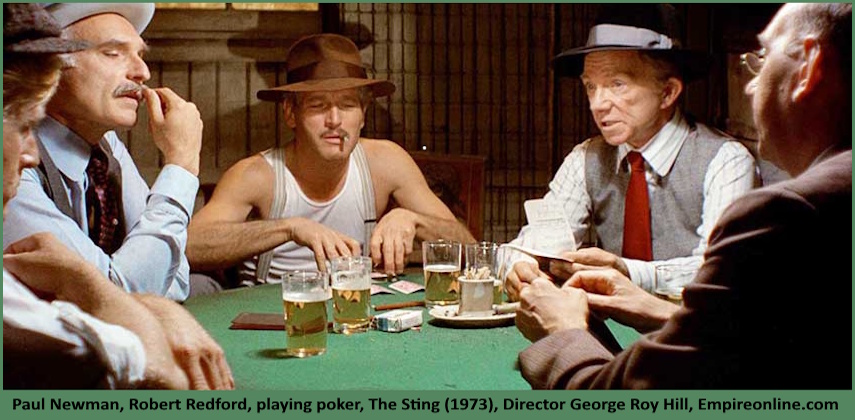
If I disagree with something, I either bet against it, or I keep silent – Amarillo Slim
It’s been a festive fifty years for the alternative investment industry, with private equity the belle of the ball. And as Chuck Prince, former CEO of Citigroup once remarked, “as long as the music is playing, you’ve got to get up and dance.” But no matter how compelling the party, there are usually a few contrarians lingering in the wings.
Ken Frier, CEO of OCIO firm Atlas Capital Advisors, wrote recently that “The signs are clear, the non-profit model, where the energy goes toward selection of alternative investment managers, is bearing less fruit.
That’s the case even for the Yale endowment – their performance beat a simple 90/10 stock/bond index portfolio by 6.2% in 1994 – 2004, by 3.6% in 2004 – 2014 and just 1.2% in 2014 – 2024. And that 1.2% in the past decade is overstated since Yale cannot sell their private holdings at the reported value.”
Maybe so, but with private equity forecast to double from $5.8tn in 2023 to $12.0tn in 2029 and the “barbarians” storming the retail 401(k) ramparts, one can’t help but wonder what the smart money is up to. As Ben Carlson, A wealth of common Sense, quipped, “being a contrarian is easier in hindsight.”
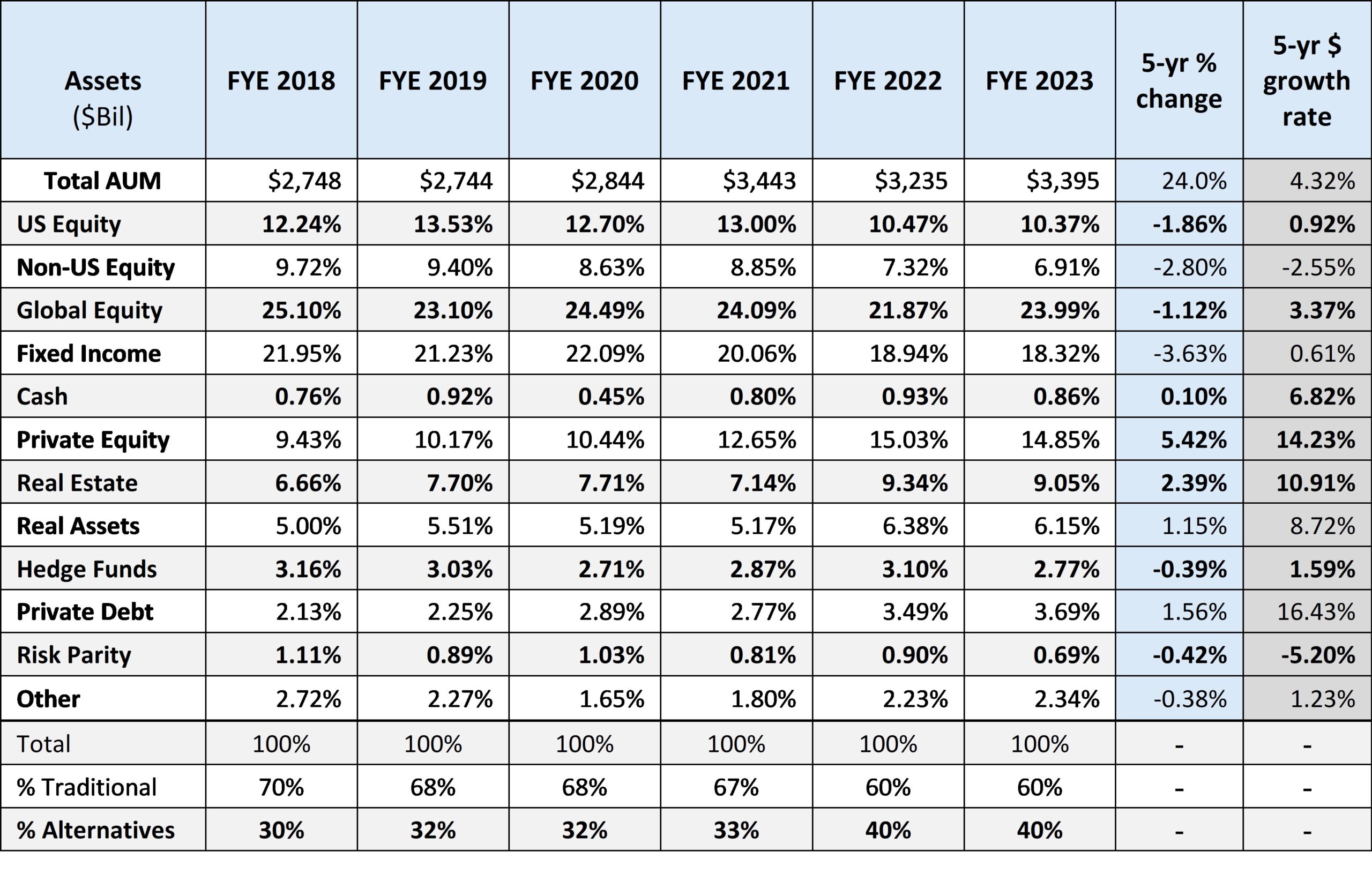
Most big dollar state pensions still follow the herd. CalPERS recently announced they’re going large on private assets with a target 40% allocation, about $225 billion of the $563 billion dollar fund.
As for CalPERS peers, Stephen L. Nesbitt, CEO & CIO of institutional consultant Cliffwater reported last year that allocations to alternatives reached 40% of state pension assets in 2022, with PE at 14.85% as of 6-30-23.
State Pension Allocations
June 30, 2018 to June 30, 2023
Non-profit Investment staffs try their best, but most go to the same conferences, use the same consultants, follow the same trends, and invest with the same managers as their peers. Career risk is too great to “think different” when politicians and media trolls lie in wait for any and every mistake.
Pinching pennies
Despite the grumbling, fees still don’t seem to matter much to the institutional crowd. Richard Ennis, former co-founder of consulting firm EnnisKnupp (now AON), thinks the herd pays too much for too little.
“Alts bring extraordinary costs but ordinary returns – namely, those of the underlying equity and fixed income assets.” Ennis finds big endowments in his study – estimated to hold 65% of assets in alternative investments – fare worse than pensions, which have a 35% exposure.
When compared with a market index that he designed with a specific stock-bond mix to mimic funds’ risk profile, endowments have trailed by 2.4 percentage points annually in the 16 years through June 2024. Over the same period, pensions undershot their benchmark by 1 percentage point a year.”
Callan recently published their 2025 Cost of Doing Business Study – “a comprehensive look at the investment management fees paid by institutional investors.” Here are a few highlights from the press release:
“Total investment management fees averaged 40 basis points (bps) across all asset pools. But this headline figure masked significant variation across investor types:
- Nonprofits continued to pay the most, averaging 57 bps, driven by larger allocations to alternatives.
- Public funds averaged 43 bps, but the largest plans resembled nonprofits in both structure and fees.
- Corporate funds averaged 30 bps, driven by growing use of liability-driven investing (LDI).
- Insurance pools, with their conservative asset allocations, were the lowest at 20 bps.”
To be fair
Read More »OCIO 2025: the winds of change
by charles | Comments are closed07/28/2025

When the winds of change blow, some people build walls and others build windmills ― Chinese proverb
There’s a lot of money to manage in this world, about $471 trillion US dollars according to the latest UBS Global Wealth Report 2025, and well over a third – $175 trillion – sits right here in our own back yard.
Last year Henley Global’s World’s Wealthiest Cities Report 2024 broke down US wealth distribution by individuals and location:

All this wealth should be good news for investment outsourcers as nonprofits and the nouveau wealthy look to offload their investment headaches. But deep-pocket competition and advances in knowledge-based technologies are changing the game. It’s no time for complacency.
Bots and bolts
Not long after we published our latest OCIO directory, I got a call from the president of a large west coast foundation, unhappy with their OCIO provider’s performance and especially unhappy with the service.
The president explained that they might have stomached the last few years of mediocre returns if communication were timely and forthright, but apparently service was half-hearted and the board had had enough. They are reviewing alternatives.
In the good old days – before TikTok and cat videos – sales, service, and steady returns were the nuts-and-bolts of money management. When Hirtle Callaghan, Commonfund, McMorgan & Company, and Strategic Investment Group hung their shingles the outsourced chief investment officer concept was fresh and intriguing. Still a tough sell, but the field was wide open.
Twenty years ago, when the Princeton Theological Seminary asked me for OCIO referrals I sent the school eight names. Today there are one hundred-eleven firms on our list, and chatbots, robo-advisors, Zoom, and cloud-based access are essential parts of the full-service landscape.
Baby boomers and Gen-Xers still crowd the boardrooms and family seats and most still prefer the human touch, but how and with whom will the next-gens invest?
Digital natives, those born in the internet age – Millennials (1980–1995), Gen Z (1995–2010), and Gen Alpha (2010 – present) – grew up with tech. As long as their assets are globally accessible, secure, and returns pay the bills they don’t seem to care much about human contact.
So, will AI replace human empathy and intuition as Mr. Zuckerberg envisions? Will “Her” soon be our most trusted companion? If so, who or what will manage our money?
Digital shadows
“Most wealth managers say they want more clients. But too often, they wait for them to show up” notes the Boston Consulting Group. But, says BCG, there are powerful tools on the horizon to support business development.
GenAI-powered prospecting engines using external data can identify and profile business owners, expats, and high-income professionals and track digital indicators that suggest investable wealth, such as business sale filings, job changes, bursts of luxury travel reviews, and niche signals like luxury car forums.
“The engine doesn’t just find names, it prioritizes them. An internal scoring system ranks each lead by value and likelihood to convert. High potential prospects can be routed directly to the most suitable advisors, complete with customized outreach packs. Every interaction – open rates, meeting conversions, follow-ups – is tracked and fed back into the model, so it gets smarter over time.”
Noah Smith, in his piece “The dawn of the posthuman age” writes:
“When I was a child, sometimes I felt bored; now I never do. Sometimes I felt lonely; now, if I ever do, it’s not for lack of company. Social media has wiped away those experiences, by putting me in constant contact with the whole vast sea of humanity. I can watch people on YouTube or TikTok, talk to my friends in chat groups or video calls, and argue with strangers on X and Substack. I am constantly swimming in a sea of digitized human presences. We all are.”
Final thoughts
Read More »